the bixby bridge concert pianist: the story behind mile 13
 By PaceKit Team · Updated April 2026 · 2 min read
Every year, at approximately mile 13 of the Big Sur International Marathon, a pianist in a tuxedo sits at a Yamaha grand piano on Bixby Creek Bridge and plays for three hours while runners cross 260 feet above the Pacific Ocean. The tradition has been part of this race since the very first running in 1986. If you've seen one image of Big Sur, it's probably this one.
how it started
The Big Sur Marathon was created by Bill Burleigh, a former Monterey County judge who wanted to stage a race on one of America's most scenic highways. From the beginning, Burleigh's vision was to make it a "classy" event, and that meant live music on the course. Long before the Rock 'n' Roll marathon series brought bands to road races across the country, Big Sur placed musicians along Highway 1: a grand piano at Bixby Bridge, Japanese taiko drummers at the base of Hurricane Point, a bagpiper on one of the last hills near mile 25, and various string quartets, jazz ensembles, and singers scattered throughout. The piano wasn't an afterthought. It was the centerpiece of the original concept.
jonathon lee
The man who made it iconic was Jonathon Lee (1953-2004), a self-taught pianist who discovered the instrument around age 13 while his family lived in San Francisco. He never had formal classical training. His style was original compositions, something close to New Age, composed to soothe and calm. He played regularly at venues around the Monterey Peninsula, including the Highlands Inn in Carmel, and his recordings were sold at Pebble Beach Golf Links.
Lee had Type 1 diabetes from the age of four. Over his life, the disease took both of his legs, his eyesight (he was legally blind), and eventually the sensation in his hands. He was a double amputee who got around Pacific Grove on an electric scooter and refused any suggestion of sheltered living. His family said he chose to "die in the saddle." He died at 51 from complications of the disease.
For 17 years, Lee was the Grand Piano Man of the Big Sur Marathon. Every race morning, a Yamaha grand piano was transported to Bixby Bridge before dawn, positioned on the south side of the deck with the Pacific visible through the railing. Wind, fog, and salt air are not kind to pianos. Lee played for three hours in a tuxedo while thousands of runners crossed. His original compositions, calm and unhurried, arrived at exactly the moment when runners were at their most depleted, descending from Hurricane Point with burning legs and ringing ears. You hear the music before you see the bridge. That contrast, silence and wind and then suddenly a piano, is what makes the moment work.
michael martinez
When a stroke limited Lee's ability to play, he began looking for someone to continue the tradition. The connection to Michael Martinez came through the Monterey County bus system. Martinez's grandfather rode the local bus with Lee, and the two became friends. Martinez was 13 when he met the Grand Piano Man.
Janet Lesniak, the race's music director, was sitting in a restaurant in Pacific Grove when she heard music that sounded exactly like Lee's recordings. It was Martinez at the piano. Lee took him on as a student and mentored him specifically for the Bixby Bridge performance. Martinez has played at the marathon every year since 2005, now over 20 years of continuation. He still performs in a tuxedo. The piano still arrives before dawn.
the bridge
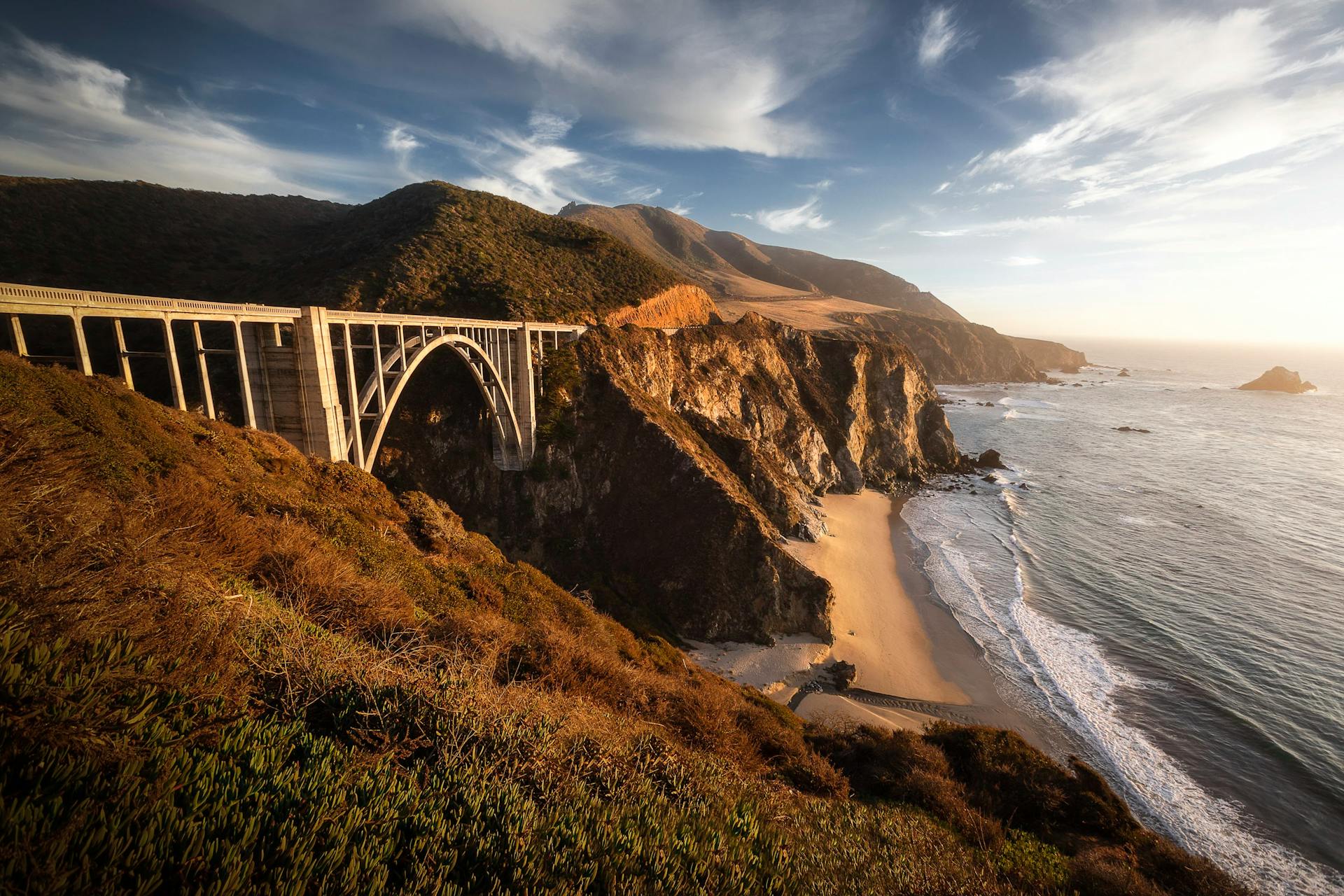
Bixby Creek Bridge is 714 feet long and 260 feet above the canyon floor, completed in 1932 using locally-sourced concrete and open-spandrel arch construction. Before it was built, this section of Highway 1 was impassable. It is the most photographed bridge in California. When Apple needed a default wallpaper for one of its major operating systems, they chose this location.
On race day, with Highway 1 closed to traffic, runners have the entire span to themselves. The piano sits on the south side, so you encounter it arriving from the Hurricane Point descent. The marathon's official photographers are positioned here too. Your Bixby Bridge photo, with the pianist behind you and the canyon below, is probably the single best race photo you will ever take.
what it feels like
Runners describe the experience consistently. You've just climbed 513 feet over two miles into crosswinds that can exceed 50 mph. Your arms are numb. The sound of the wind has been deafening. Then you crest Hurricane Point at 560 feet, the wind drops, and the descent begins. Somewhere during that descent, before you can see the bridge, you hear piano music carrying up from the canyon. By the time you reach the bridge at mile 13, the halfway point, a man in a tuxedo is playing original compositions on a grand piano 260 feet above the ocean while you run past.
Thousands of runners have added minutes to their finish times by stopping at the bridge. Some cry. Some take photos. Some just stand there. It arrives at exactly the moment when you need something, and it delivers something no one expects to find in the middle of a marathon.